

In 2026, AI is moving beyond concepts and penetrating every facet of the security industry.According to Fortune Business Insights,the global AI in video surveillance market size was valued at USD 6.26 billion in 2025. The market is projected to grow from USD 7.04 billion in 2026 to USD 26.90 billion by 2034, exhibiting a CAGR of 18.2% during the forecast period.
Driven by the rapid replacement of conventional surveillance hardware with 4K ultra HD AI cameras equipped with edge computing capabilities, security system upgrades are being rolled out on a large scale across residential communities, industrial parks, campuses and manufacturing facilities — marking the advent of the AI powered surveillance era.
Smart features including facial recognition, fire smoke detection and cross line alert have resulted in a substantial increase in bitrate per video stream.
Meanwhile, numerous system integrators report two critical drawbacks of legacy networking solutions: insufficient uplink bandwidth on standard switches and inadequate PoE power budget. When multiple AI powered surveillance cameras go live simultaneously, issues such as video stuttering and camera offline status frequently occur, preventing the entire security system from operating reliably.
Consequently, for high density camera deployments, industrial switches featuring 10G uplink, Layer 3 management and high power PoE supply have become a must have for project acceptance.
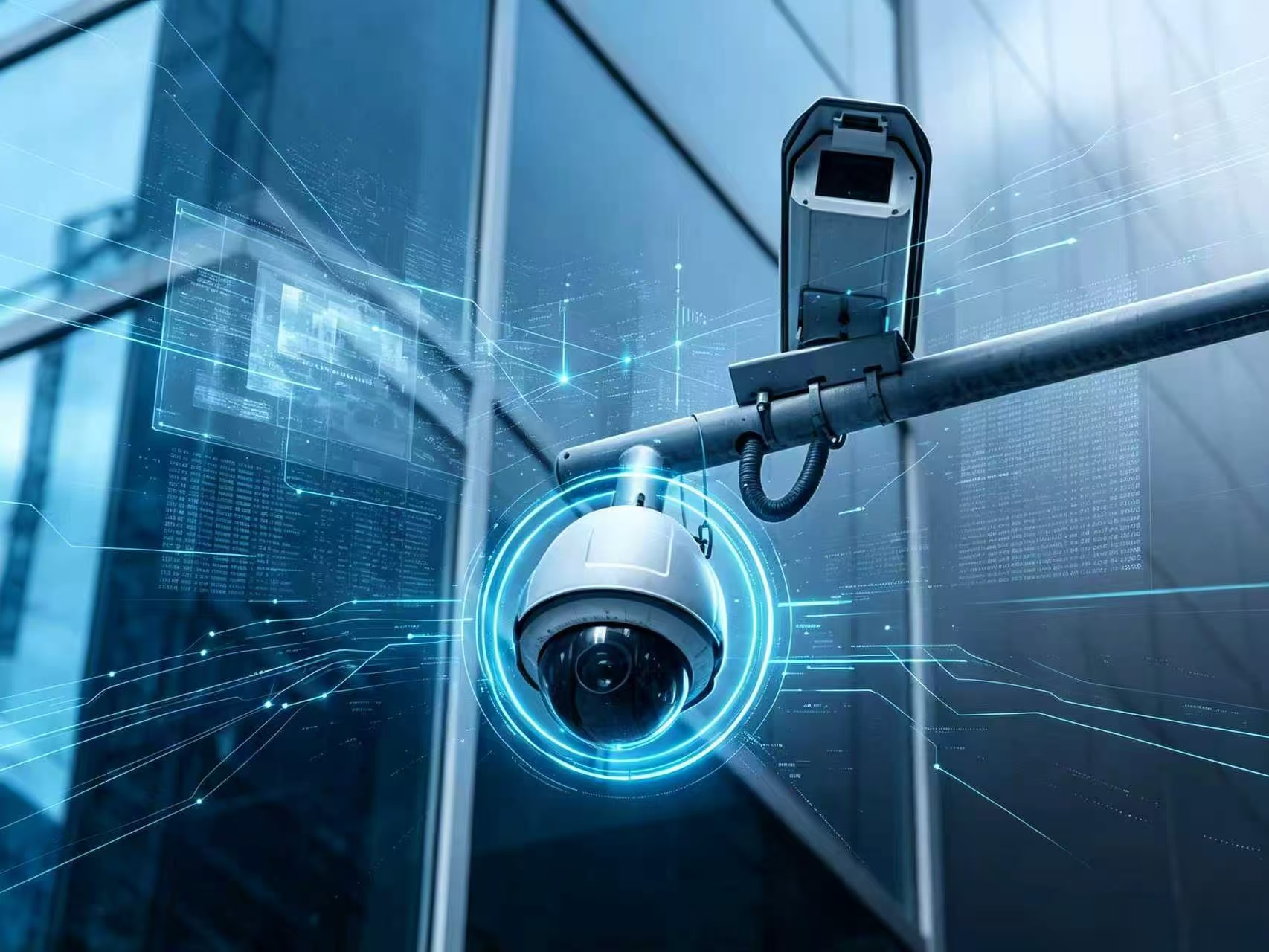
1. Three Core Pain Points of AI Security Networking at Present
These underlying issues reflect unavoidable practical contradictions in the construction of AI security networks. On one hand, AI cameras generate massive volumes of data, high-concurrency traffic and impose stringent power supply requirements; on the other hand, traditional gigabit switches can no longer withstand such heavy intelligent workloads. When intelligent applications collide with traditional network infrastructure, switches serving as core network hubs move from the background to the forefront, emerging as the decisive factor for stable system operation.
(1) Bandwidth Surge — 4K/8K Traffic Turns Gigabit Uplink Into a Bottleneck
While conventional surveillance systems relied on 1080P resolution, AI security has fully stepped into the ultra-high-definition era of 4K and even 8K. The sharp rise in pixel density delivers clearer video footage, yet it also triggers an overwhelming surge in bandwidth demand. A single 4K camera outputs a real-time bitrate exceeding 20 Mbps. When hundreds of video streams transmit concurrently in parks, factories and other sites, traditional switches with gigabit uplinks quickly suffer severe network congestion. Not only does high-definition video become choppy and unsmooth, but the efficiency of back-end AI algorithms in capturing and analyzing key frames is also drastically reduced.
(2) Absence of Network Isolation in Layer 2 Architecture, Broadcast Storms Disrupt the Entire Network
Insufficient bandwidth can be likened to an overly narrow roadway, while the inherent drawbacks of traditional Layer 2 networking architecture are equivalent to all vehicles travelling on an undivided single lane. In flat networks without VLAN isolation, broadcast packets generated by a faulty camera can spread rapidly across the whole network like a virus, triggering network-wide broadcast storms. Consequently, all surveillance videos freeze up and storage devices lose network connections.
(3) Insufficient Power Output Causes Frequent Disconnections of AI Cameras
Integrated with high-performance edge computing chips and 4K image sensors, AI cameras consume far more power than what conventional PoE standards can adequately support. Ordinary switches only adhere to the IEEE 802.3af standard, providing a maximum output of 15.4W per port. In contrast, high-definition cameras equipped with AI chips and infrared supplementary lighting reach a peak power consumption of nearly 30W. Inadequate power reserve leads to repeated device reboots, disabled infrared lighting at night and failed surveillance coverage during critical time periods.
2. Four Core Hardware Indicators That Enable Switches to Handle Massive 4K Video Traffic
Now that the three major pain points — bandwidth congestion, flat network structure and insufficient power supply — have been clearly identified, what kind of switches can reliably withstand the heavy load of 4K AI security video streams?
The solution is not merely purchasing more expensive hardware. Instead, it requires an upgrade of generational performance based on the underlying logic of network architecture, with comprehensive improvements across four dimensions: bandwidth, networking design, power supply and hardware specifications.
(1) 10G SFP+ Uplink Ports
Massive uplink bandwidth delivers wire‑speed forwarding for multiple 4K video streams with zero latency and zero frame loss.
(2) Layer 3 Routing Capabilities
Layer 3 switches support static routing and RIP dynamic routing. They enable users to divide monitoring zones and office networks into independent VLANs for thorough broadcast domain isolation.More importantly, comprehensive IGMP multicast protocol support multiplies the transmission efficiency of massive AI video streams within multicast environments. Unlike Layer 2 switches that flood traffic via one-to-many broadcasting, these devices greatly ease overall network load.
(3) High-Power PoE Power Supply
Each port delivers a full 30W output under full load. It reliably powers AI PTZ cameras with infrared night vision as well as outdoor cameras equipped with heating and defogging modules for steady operation.
(4) Industrial-Grade Reliable Hardware
Featuring robust housings, wide-temperature tolerance and strong anti-interference performance, the switches adopt redundant ring network protocols to achieve millisecond-level self-recovery upon line faults, ensuring non-stop security surveillance all year round.
3. CF-HY4T8024GP-SFP: The Ideal Solution Tailored for Your AI Security
Scenarios Driven by the wave of AI surveillance upgrades, park networks are confronted with challenges of higher port density and more complex access deployment. Developed independently by CF FIBERLINK, the CF-HY4T8024GP-SFP is a Layer 3 managed industrial PoE switch equipped with 4×10G SFP+ optical ports, 24 Gigabit electrical ports and 8 Combo ports. It delivers an all-in-one solution to efficiently resolve networking difficulties for high-density park deployment.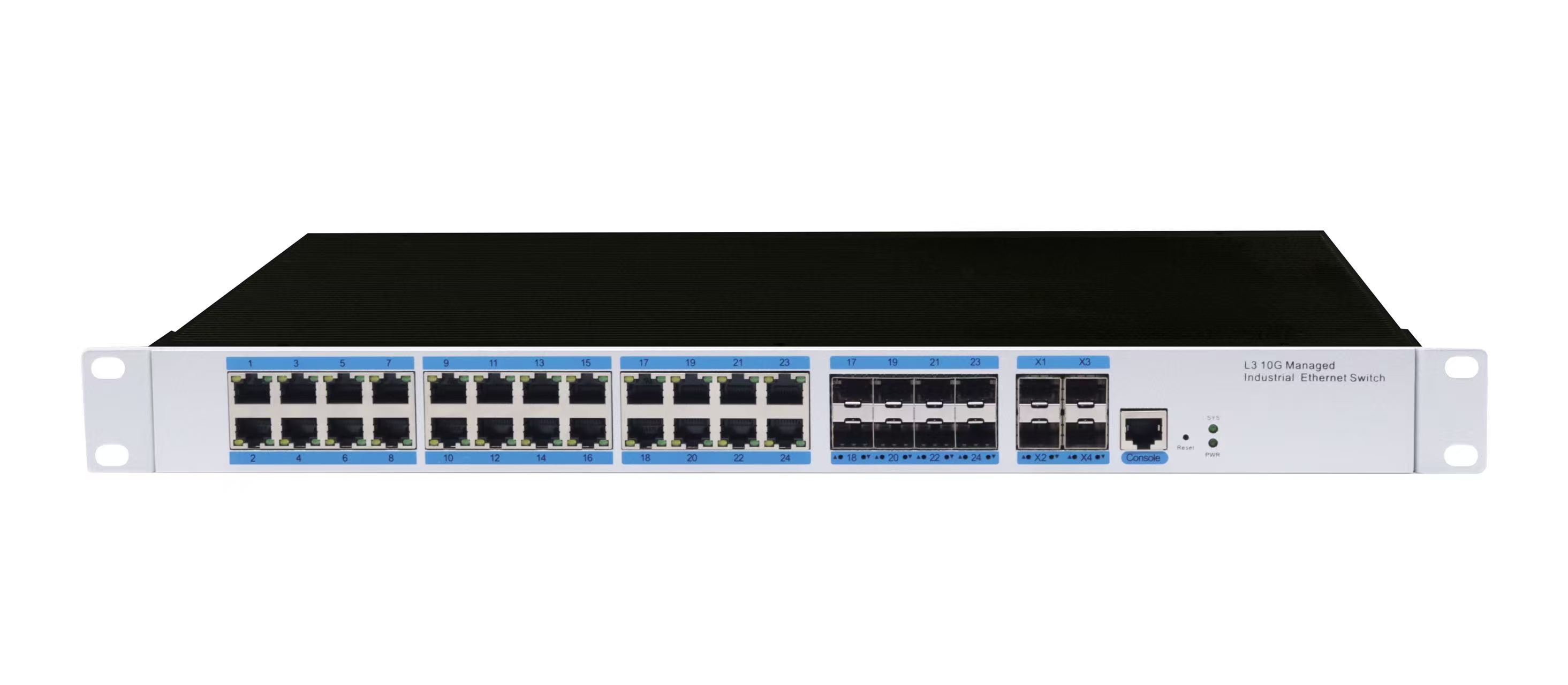
(1) Four 10G SFP+ Uplink Optical Ports to Fully Eliminate Bandwidth Bottlenecks
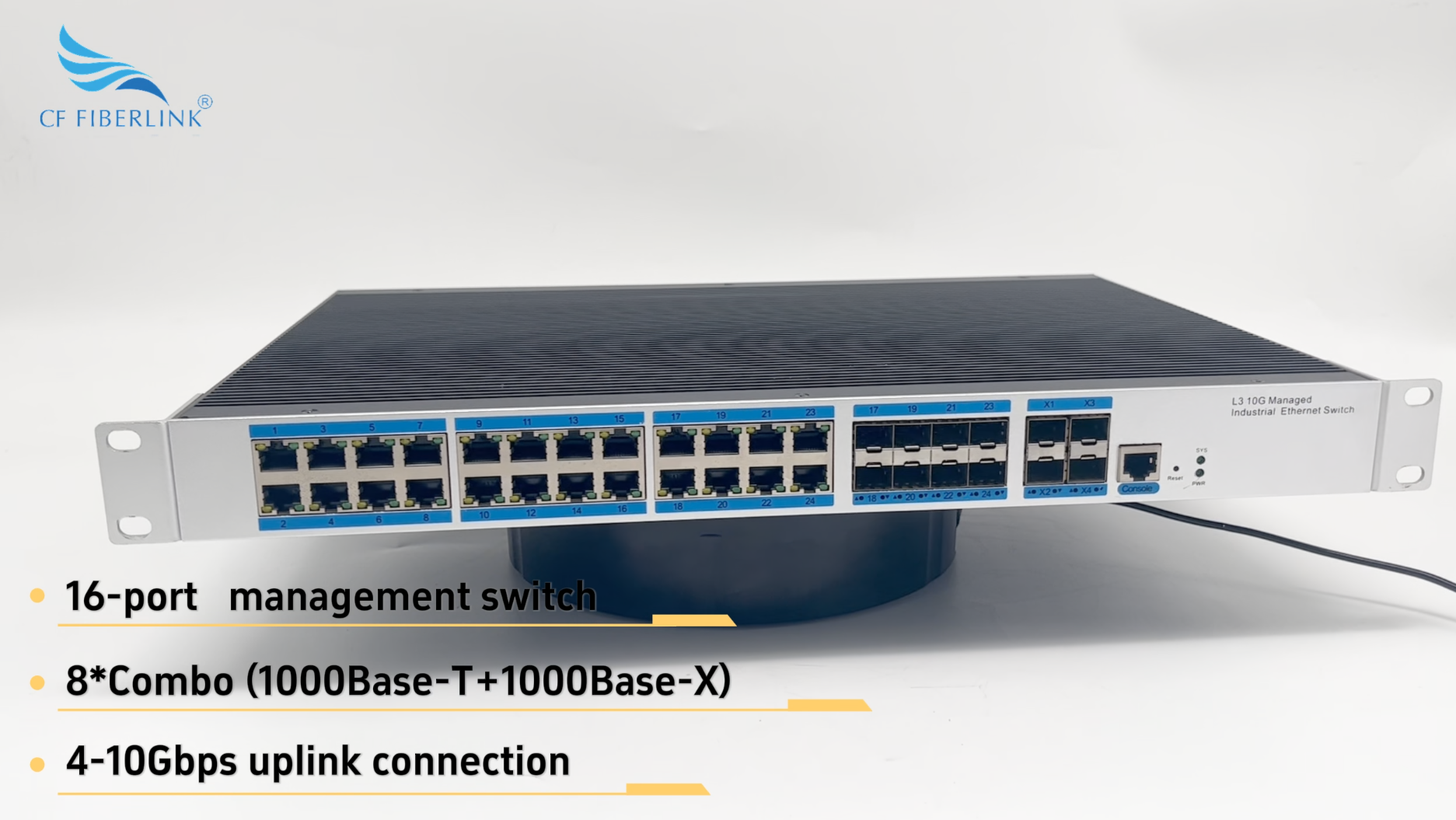
The CF-HY4T8024GP-SFP comes with four 1/10G SFP+ uplink slots, delivering an aggregated uplink bandwidth up to 40Gbps. It effortlessly accommodates massive 4K and 8K video streams, rendering the bandwidth limitations of gigabit uplinks a thing of the past.
(2) 24 Gigabit PoE Ports with 450W Total Power Output to Maintain Stable Power Supply for AI Cameras
Ports 1 to 24 of this switch all support PoE power supply compliant with IEEE 802.3af/at standards. The device automatically identifies compatible powered devices and transmits data alongside power simultaneously via Ethernet cables. Each port offers a baseline power output of 15.4W with a peak power capacity of 30W. Built with a 450W high-power internal power supply, it easily fulfills centralized power demands for large quantities of AI cameras and PTZ cameras, completely avoiding unexpected disconnection issues.
(3) Comprehensive Layer 3 Managed Functionality: A Barrier Against Broadcast Storms
The CF-HY4T8024GP-SFP supports static routing and comprehensive ACL access control. Combined with VLAN as well as STP/RSTP/MSTP spanning tree protocols, it isolates broadcast domains at the network layer to curb the spread of broadcast storms and safeguard the stable operation of core services.
In terms of security protection, the switch integrates multiple defense mechanisms to block virus proliferation and network attacks, and precisely restrict unauthorized access so as to guarantee reliable connectivity for legitimate users. A full array of functions including static/dynamic port binding, port isolation, hardware-based ACL policies, flow-based bandwidth control and multi-factor access authentication collectively build a robust security shield for your network, enabling rational resource allocation and orderly network operation.
(4) Rugged Industrial-Grade Design & Flexible Combo Ports: Adaptable to Harsh Environments and Diverse Transmission Links
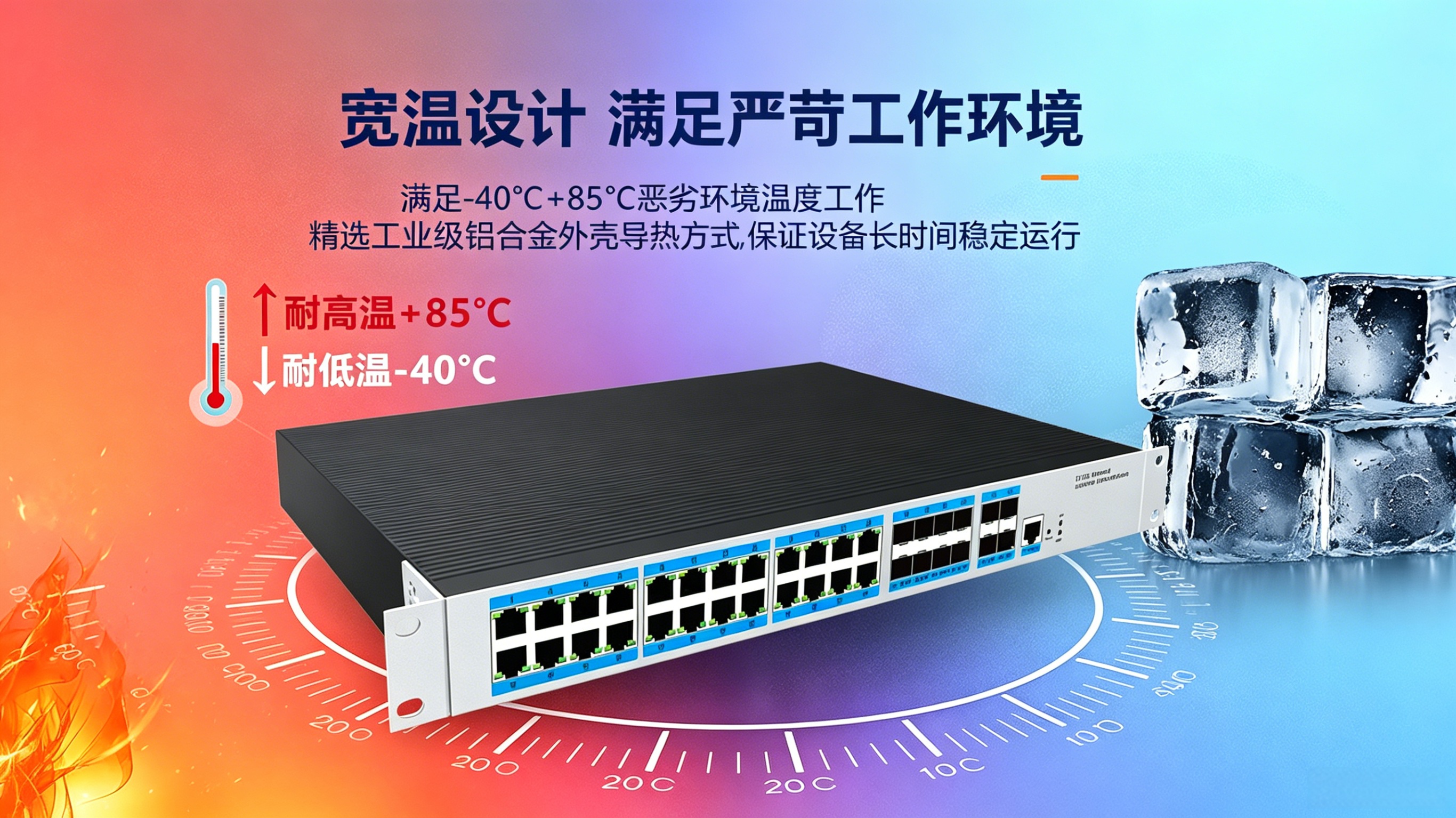
Built in strict accordance with industrial specifications, the CF-HY4T8024GP-SFP adopts mature industrial chips, high-performance industrial CPUs and industrial power modules sourced from top international suppliers. Equipped with an aluminum alloy enclosure, it delivers solid structural strength and efficient heat dissipation. With fan-assisted cooling circuitry, the switch works steadily across a wide temperature range of -40℃ to +85℃, features IP40 ingress protection, and boasts port lightning protection up to 6KV. Additional designs such as anti-vibration power supply protection and Level 4 EMC anti-interference capability grant it outstanding shock and vibration resistance. It operates reliably long-term inside outdoor enclosures, roadside cabinets and factory workshops alike.
Furthermore, the switch is equipped with 8 Combo ports featuring flexible Gigabit electrical/optical multiplexing. Users may freely choose fiber or copper cable connections according to on-site cabling conditions without extra media converters, making it ideal for legacy park renovation and complicated networking deployments.
4. Practical Application Scenarios
- Integrated projects combining high-definition AI surveillance and wireless coverage for campuses and hospitals
- Security upgrading for large residential communities and industrial and commercial parks
- Hybrid networking integrating machine vision and security monitoring for industrial parks and logistics warehouses
- Comprehensive cabling for smart buildings including video intercom systems and facial recognition access control
5. Let Your AI Surveillance Never Be Held Back by an Inadequate Switch
With the widespread rollout of AI intelligent surveillance, high bandwidth, high-power PoE supply and stable isolated networking have turned into essential prerequisites for security projects. Conventional Layer 2 and full-gigabit switches are unable to accommodate the requirements of next-generation intelligent hardware. 10G Layer 3 industrial PoE switches stand as the most ideal option for park renovation nowadays.
The CF-HY4T8024GP-SFP integrates outstanding bandwidth performance, robust power output, comprehensive network management and industrial-grade durability. A single device covers both access and aggregation scenarios, substantially cutting total expenditures on cabling, equipment purchase and daily operation and maintenance.
Post time: Aug-15-2026