

The discrepancy does not stem from inherent flaws in fan technology itself; rather, operating conditions in enterprise server rooms differ drastically from those on factory shop floors.
Enterprise server rooms feature constant temperature, clean air and scheduled routine maintenance, making fan-assisted cooling a viable option. In contrast, industrial workshops suffer from heavy dust accumulation, drastic temperature fluctuations, sealed control cabinets, and numerous unattended deployment points running round the clock. Under such harsh conditions, the drawbacks of fan-equipped switches become increasingly pronounced over time.
For this reason, DIN-rail mounted industrial switches intended for on-site field deployment predominantly adopt fanless passive cooling architecture as the preferred design.
01. Why Are Fan-Cooled Switches Not Recommended for Industrial Field Environments?
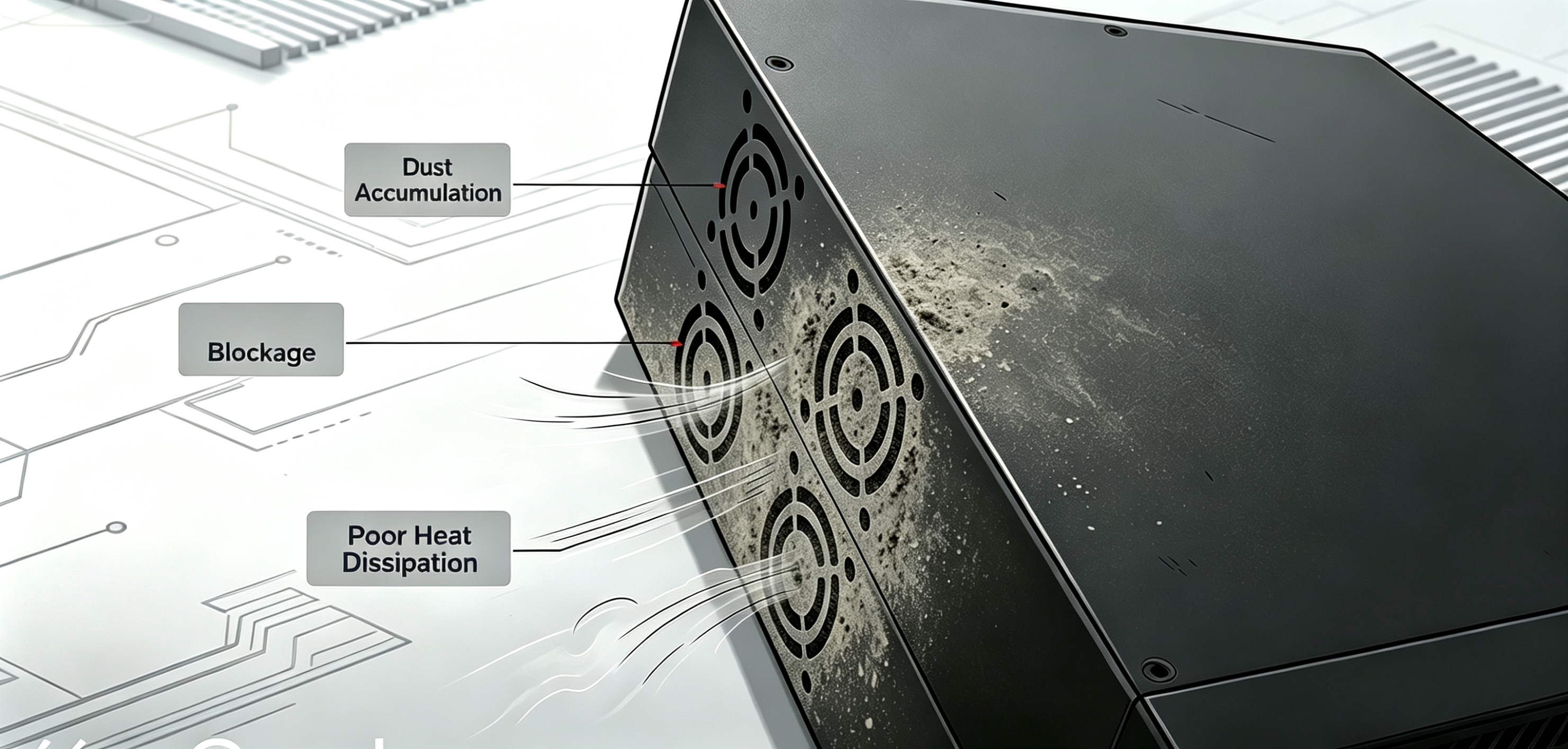
The biggest downside of fan-equipped switches lies in their poor adaptability to harsh industrial operating conditions.
Fans are the primary wearing components of the whole device. Circuit boards, Ethernet ports and power supply systems can operate stably for years, yet cooling fans are consumable parts prone to breakdowns within 2 to 3 years, leading to high maintenance costs. Industrial production lines run 24/7 nonstop; fans tend to degrade or stall as time passes. Once heat dissipation fails, the equipment will overheat rapidly and shut down unexpectedly.
Ventilation openings inevitably accumulate large amounts of dust.
Devices fitted with fans have to be designed with air vents. In workshops for 3C manufacturing, lithium batteries, injection molding, woodworking and other industries, dust, fiber debris and oil fumes are continuously drawn into the interior. Long-term buildup clogs air ducts and disables heat dissipation directly. Trapped heat forces chips to work under persistent high temperatures, triggering system crashes and network outages, which severely disrupt continuous production on the production line.
Limited waterproof and moisture-proof performance.
Fan-equipped devices cannot be fully sealed. Moisture and corrosive gas can seep inside through the vents, corroding circuit boards and metal contacts. This drastically reduces the equipment’s dustproof and damp-proof performance, making it unfit for complex industrial scenarios.
Insufficient heat dissipation inside sealed electrical control cabinets.
Most industrial switches are installed inside enclosed control cabinets with poor air circulation. Fan-cooled units suffer drastically reduced cooling efficiency in such confined spaces, which commonly causes chips to throttle due to excessive heat. This jeopardizes the communication stability of machine vision systems, AGVs and PLC control links.
02. Passive Cooling Principle of Fanless Industrial Switches
Fanless models abandon active air cooling driven by fans. Instead, they dissipate internal heat mainly via thermal conduction and natural convection, supplemented by thermal radiation. This design fundamentally eliminates hidden troubles caused by fans, such as dust intake and mechanical failures.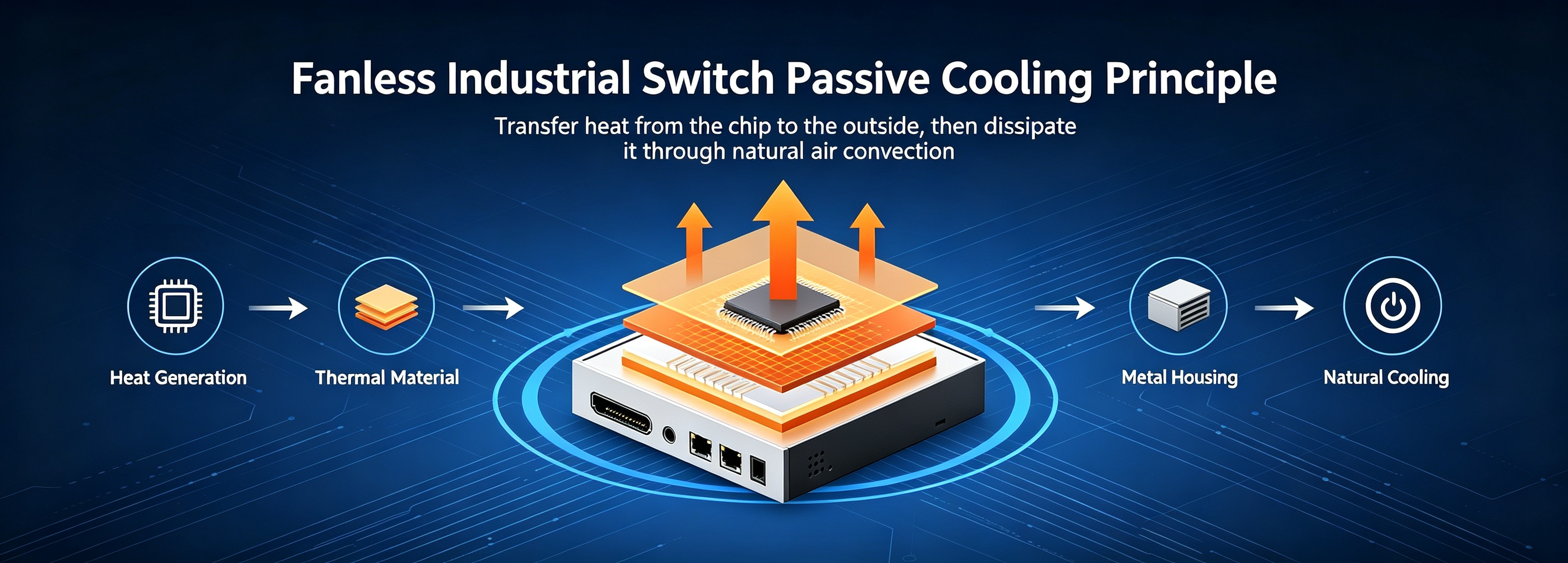 Cooling Mechanism: Heat generated by internal PoE chips, power management ICs and main switching chips is quickly transferred to the aluminum alloy enclosure via high thermal conductivity gaskets closely attached to the chips. The aluminum housing adopts large-area cooling fins to expand contact area with ambient air, releasing heat to the surrounding environment through natural convection. The entire heat dissipation process involves no fans, no ventilation holes and no moving parts, thoroughly preventing equipment malfunctions triggered by dust buildup on fans or bearing wear.
03. Four Core Industrial-Grade Advantages of Fanless Design
Fully Sealed Housing for Superior Dust and Moisture Resistance
With no ventilation openings, the fully enclosed structure blocks dust, moisture and oil fumes from penetrating the device interior. It effectively prevents faults including circuit board corrosion and oxidation of metal contacts.
No Consumable Components to Ease Maintenance Burden
Without fan aging or clogging issues, the service life of the equipment can match the lifecycle of automated production lines. Frequent disassembly for dust cleaning and part replacement are no longer required. Eliminating the risk of fan failure drastically cuts long-term maintenance workload and costs.
Aluminum Alloy Housing with Built-in Electromagnetic Shielding Performance
The metallic enclosure effectively resists electromagnetic interference generated by frequency converters and motor startup/shutdown on the production floor, ensuring stable transmission of industrial control signals and high-definition visual data streams.
Wide Operating Temperature Range for Complex Thermal Conditions
It delivers stable operation across a broad temperature spectrum. The device runs continuously and reliably whether exposed to high temperatures inside enclosed cabinets in summer or low-temperature surroundings in winter.
04. CF FIBERLINK Industrial-grade Switches: Fanless Cooling Design & Comprehensive Industrial-grade Quality
Tailored for harsh working conditions including workshop electrical control cabinets, dusty environments and unattended operation scenarios, CF FIBERLINK industrial switches adopt a fanless aluminum alloy housing cooling structure by default. With zero moving parts inside the device, the design physically blocks dust ingress risks and eliminates mechanical failures caused by fan bearing wear. Equipped with the following multiple industrial‑grade hardware protection features to deliver long‑term and reliable network assurance for production lines:
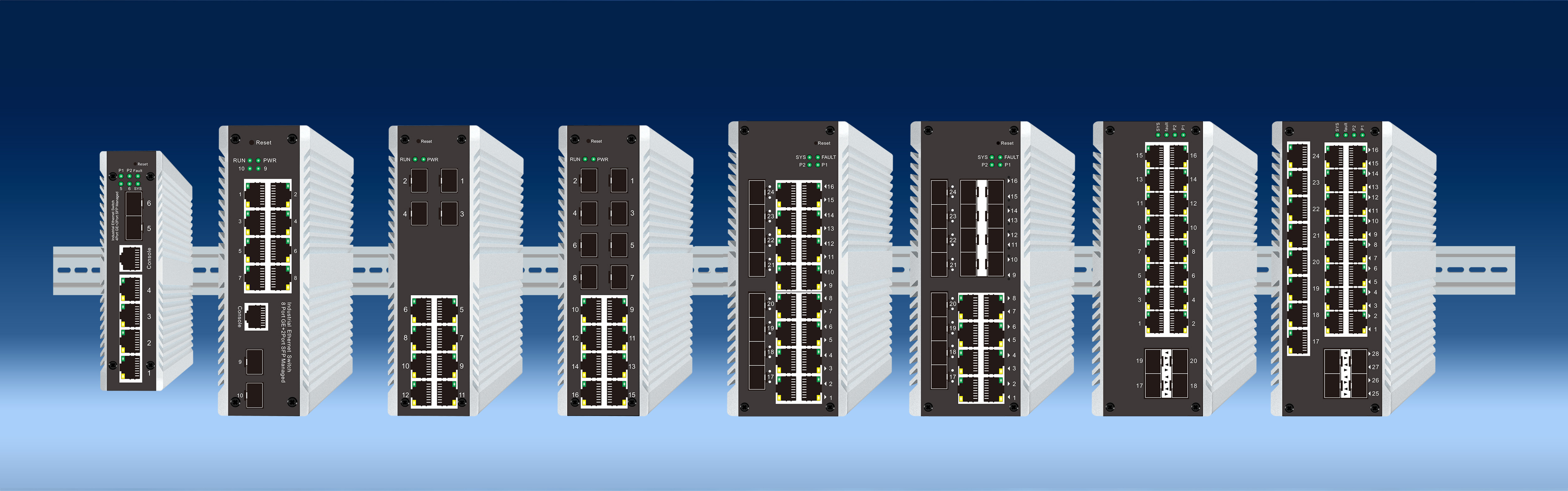
- Standard DIN‑rail mounting: Fits compact space inside electrical control cabinets with no separate mounting position required;
- Aluminum alloy housing: One‑piece metal enclosure with fanless passive cooling, vibration and shock resistance for harsh workshop operating conditions;
- IP40 overall protection rating: Dust‑proof enclosure prevents dust and debris from entering the device, ideal for dusty workshop environments;
- 6KV port surge protection: Withstands plant‑site surges and induced lightning strikes to ensure stable operation during thunderstorm seasons;
- Extended operating temperature range of ‑40℃ ~ +85℃: Tolerates extreme conditions including high‑low workshop temperatures, outdoor sun exposure and high heat within sealed cabinets;
- Dual wide‑voltage redundant power input: Supports dual DC redundant power supply with reverse‑polarity, over‑current and over‑voltage protection; services keep running upon failure of one power path.
With the rapid advancement of factory digital transformation, long-term equipment reliability has evolved from an optional feature into a fundamental requirement. Built with robust industrial-grade hardware design, the full range of CF FIBERLINK fanless industrial switches delivers lasting, stable data transmission for your production-line networks.
05. Application Scenario Differentiation
✅ Applicable Scenarios for Fan-Cooled Switches
Suitable for environments with clean air, constant temperature and humidity, and regular maintenance: enterprise server rooms, weak current rooms in office buildings; 10G high-bandwidth aggregation networks and high-density core network nodes; standard indoor environments free from dust and strong electromagnetic interference.
✅ Applicable Scenarios for Fanless Industrial Switches
Suitable for installation within enclosed electrical control cabinets on production floors; dusty and oil-fume-prone working conditions such as 3C manufacturing, lithium battery production and injection molding; 24/7 uninterrupted production lines equipped with machine vision systems and AGV clusters; unattended outdoor facilities including photovoltaic power stations, water pumping stations and tunnels; industrial retrofitting projects requiring long-term low failure rates and maintenance-free operation.
06. Conclusion
There is no absolute superior or inferior cooling solution; the deciding factor lies entirely in scenario adaptability. Fan-cooled switches are ideal for standardized server rooms with favorable ambient conditions, while fanless variants are designed to cope with complicated and harsh industrial field environments. For front-end access on production lines and networking under severe working conditions, fanless industrial switches serve as an excellent option to guarantee long-term stable network operation.
Post time: Aug-22-2026