

According to data from Mordor Intelligence industry report, the global PoE++ switch market will reach USD 1.57 billion in 2026, with a compound annual growth rate (CAGR) of 10.44% from 2026 to 2031. Among all product categories, high -power models ranging from 60W to 90W achieve an impressive growth rate of 18.4%, leading the whole industry segment.
Three key factors drive this growing market demand. First, smart transformation and digital upgrading of manufacturing plants are fully underway. The wide adoption of AI vision systems and flexible wireless production lines doubles power consumption of field -side terminals. Second, IT- OT network convergence enables unified copper -cable networking inside workshops, simplifying cabling work and cutting construction costs. Third, increasing investment in smart manufacturing and digital infrastructure across Asia -Pacific fuels massive renovation demands from domestic factories.
So what exactly is PoE++? Why are PoE++ switches gaining growing popularity within automated production lines?
1. What is PoE++
PoE stands for Power over Ethernet. At its core, this technology enables both data and power transmission over a single Ethernet cable, eliminating the need for separate power cables and external power adapters. PoE++, formally defined under IEEE 802.3bt (also known as the BT standard within the industry), represents the highest -power PoE specification available today. Unlike previous- generation standards that deliver power over only two twisted -wire pairs inside the cable, PoE++ utilises all four twisted pairs simultaneously for power delivery, supporting two power output levels.
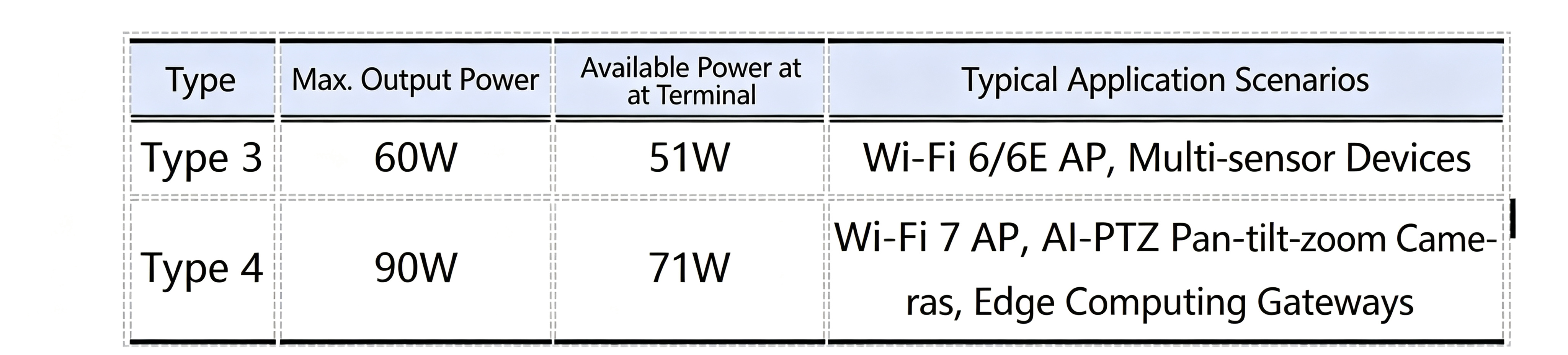
Practical available power for PoE++ end- devices far exceeds that of earlier- generation PoE standards, making it purpose- built for high- power -consumption industrial terminals.
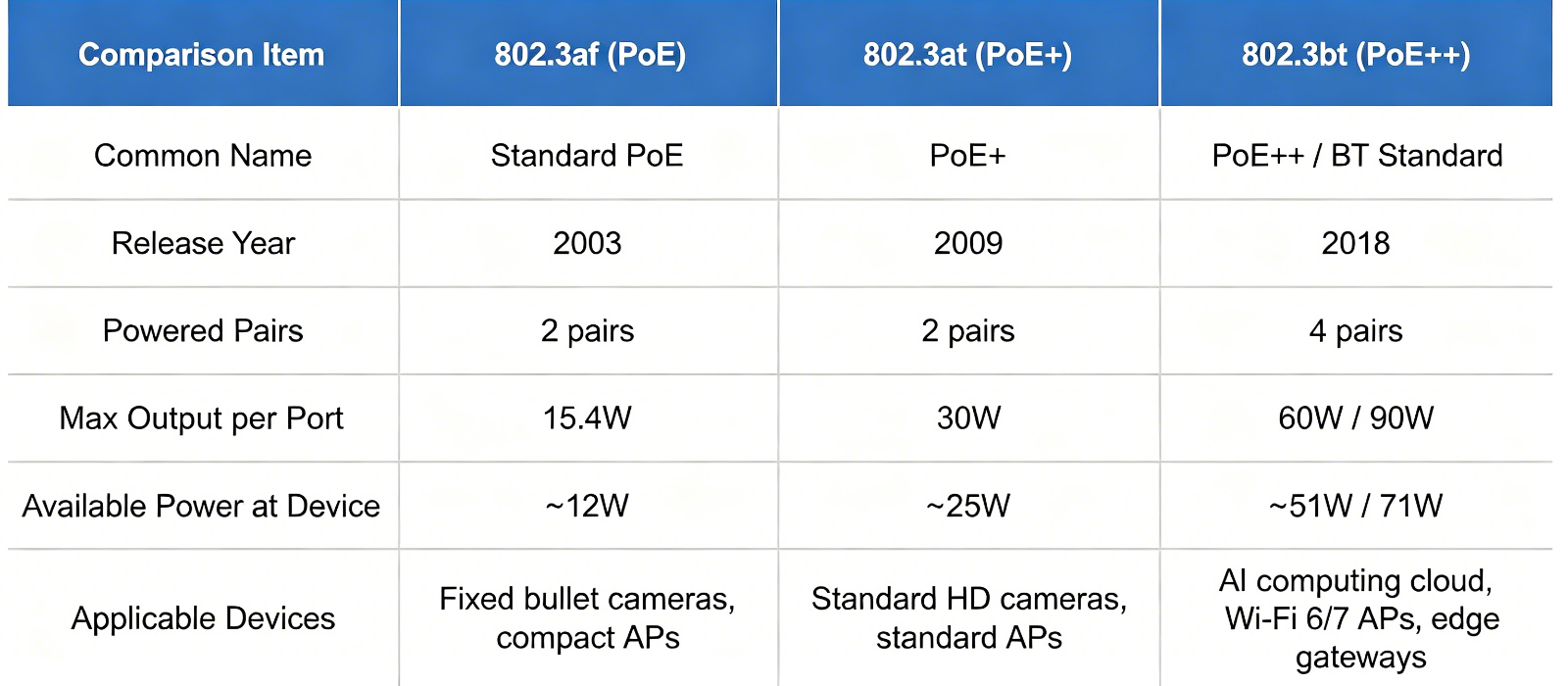
2. Comparison of Three Generations of PoE
(1) 802.3af (PoE):
Released in 2003, it is the earliest PoE standard. Power is delivered only over two twisted wire pairs within Ethernet cables. It delivers up to 15.4 W per port, with roughly 12 W available at the end device. It fits low- power devices such as fixed box cameras and compact indoor APs. It cannot drive PTZ cameras or high- power wireless hardware; forced power supply will trigger frequent rebooting or device failure to power -on.
(2) 802.3at (PoE+):
Released in 2009, it also uses two twisted- wire pairs for power delivery. Per port output rises to 30 W, providing approximately 25 W usable power for end -devices. It was widely adopted for small -to -medium production lines in the past. It can only support ordinary high -definition cameras. Devices equipped with heaters, motors or multi -radio modules suffer insufficient power under full load, resulting in speed throttling and rebooting, which raises hidden risks of production- line downtime.
(3) 802.3bt (PoE++):
Released in 2018, it is currently the highest -power PoE standard. It leverages all four twisted -wire pairs inside the cable for concurrent power delivery, delivering a maximum 90 W per- port output with 71 W practical usable power at end- devices. High- power- consumption terminals including AI PTZ cameras, Wi Fi 6 APs and edge- computing gateways run stably at full power without throttling, sleep or rebooting, keeping critical production- line devices online continuously.
3. Core Advantages of PoE++ Compared With Conventional Power Supply Solutions
(1) Simplified Cabling: Under conventional solutions, separate power cables and Ethernet cables have to be laid for cameras, APs and other devices. This leads to cluttered cabling inside cabinets and long construction cycles. PoE++ only requires one single Ethernet cable to transmit both power and data, removing the need for power adapters and freeing up cabinet space.
(2) Stable Operation: With full power output up to 90 W per port, PoE++ guarantees end -devices run under full load conditions. It prevents device reboot or performance degradation caused by insufficient power supply and eliminates hidden downtime risks on production lines.
(3) Easy Operation & Maintenance: Managed PoE++ switches allow remote monitoring of power status and power -consumption data for each port via backend systems. Remote port on -off control is supported, so on- site disassembly is unnecessary for fault troubleshooting.
(4) On Site Deployment: Designed for industrial control cabinets, it supports installation via DIN -rail clips. No dedicated mounting position is required. The unit can be fixed directly inside control cabinets to save space and facilitate maintenance.
4. CF FIBERLINK Industrial- Grade PoE++ Switches for Full- Scenario Production Line Applications
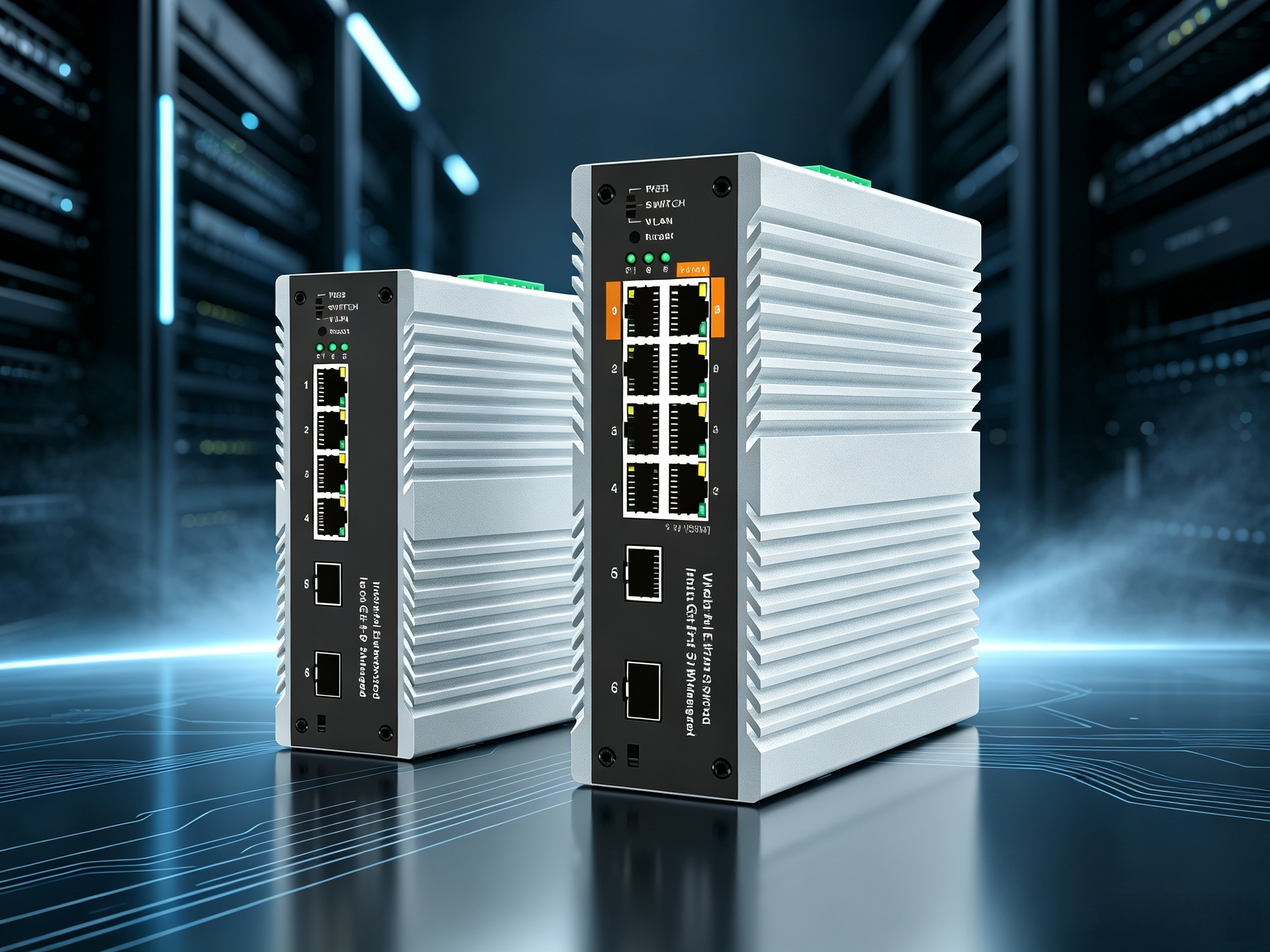
Workstations of varying scales have distinct requirements for port count and management capabilities of high -power PoE switches. CF FIBERLINK has launched two DIN- rail mounted industrial PoE++ switches complying with BT standard. They precisely cover two major networking scenarios: small -scale distributed workstations and complete large-scale production lines, enabling users to select proper models without wasting device performance.
(1) 2 -Fiber 4 -Port PoE++ Switch (Ideal for Small Scale Workstations and Distributed Nodes)
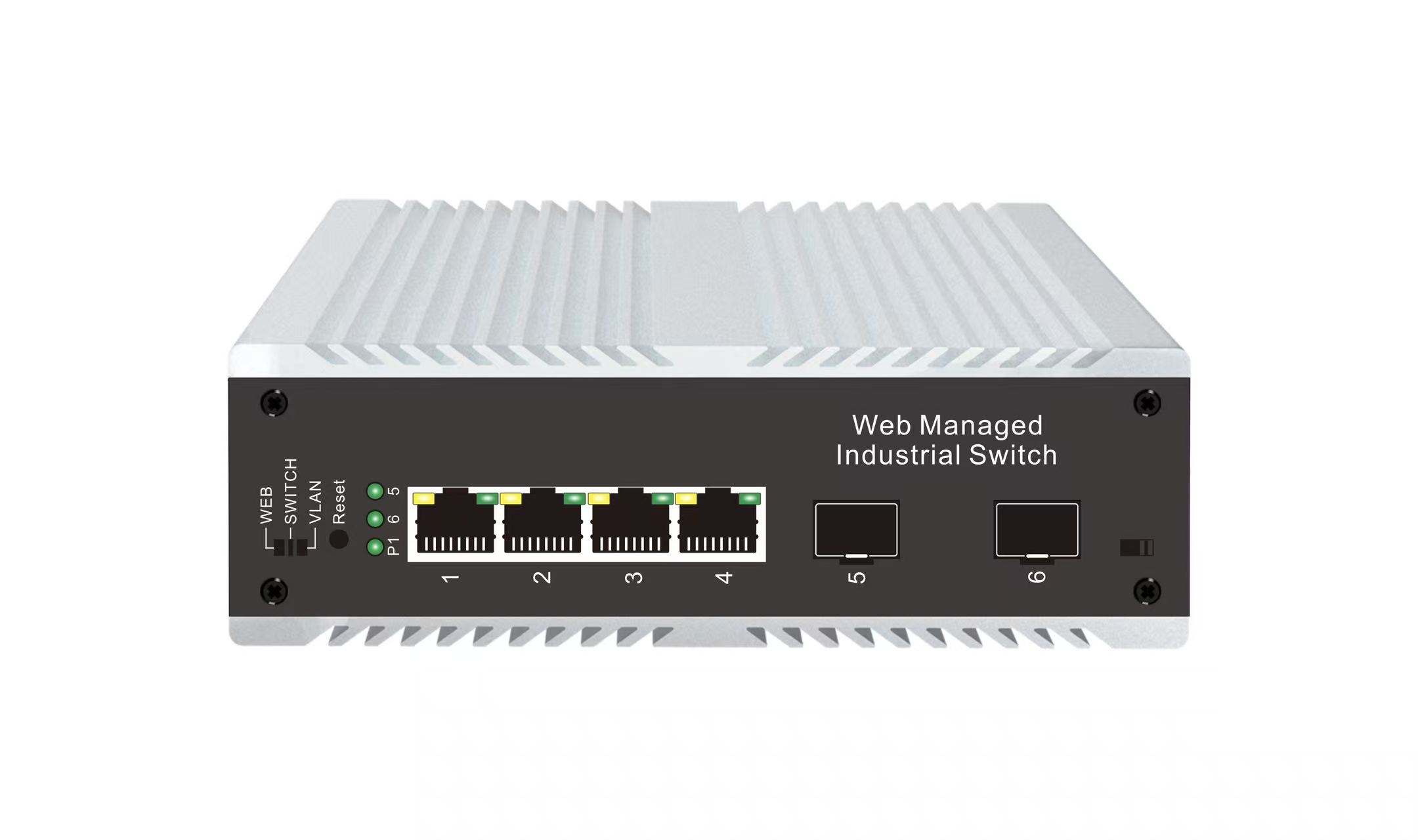
This model is equipped with 4 IEEE 802.3bt 90W PoE copper ports and 2 independent SFP fiber uplink ports. All ports deliver high- power output compliant with the BT standard. Each port can reliably power high- consumption end -devices such as AI PTZ cameras and industrial Wi Fi6 APs, without concerns over insufficient concurrent power supply, device frequency throttling or sleep mode.
The device comes with full- featured web- based visual network management. Engineers can monitor real -time power consumption and online status of every PoE port via web browser. Remote port on/off control and PoE power priority configuration are supported. On- site disassembly is not required for single- site fault diagnosis.
Its compact form factor fits perfectly for standalone inspection stations, scattered workshop sorting points and small lab equipment cabinets. It can be directly clipped onto DIN rails for local installation and takes minimal cabinet space. It is a cost -effective choice for small- scale deployments with up to four end nodes.
(2) 2 -Fiber 8- Port PoE++ Switch (Ideal for Full -Production- Line and Large -Area Networking)
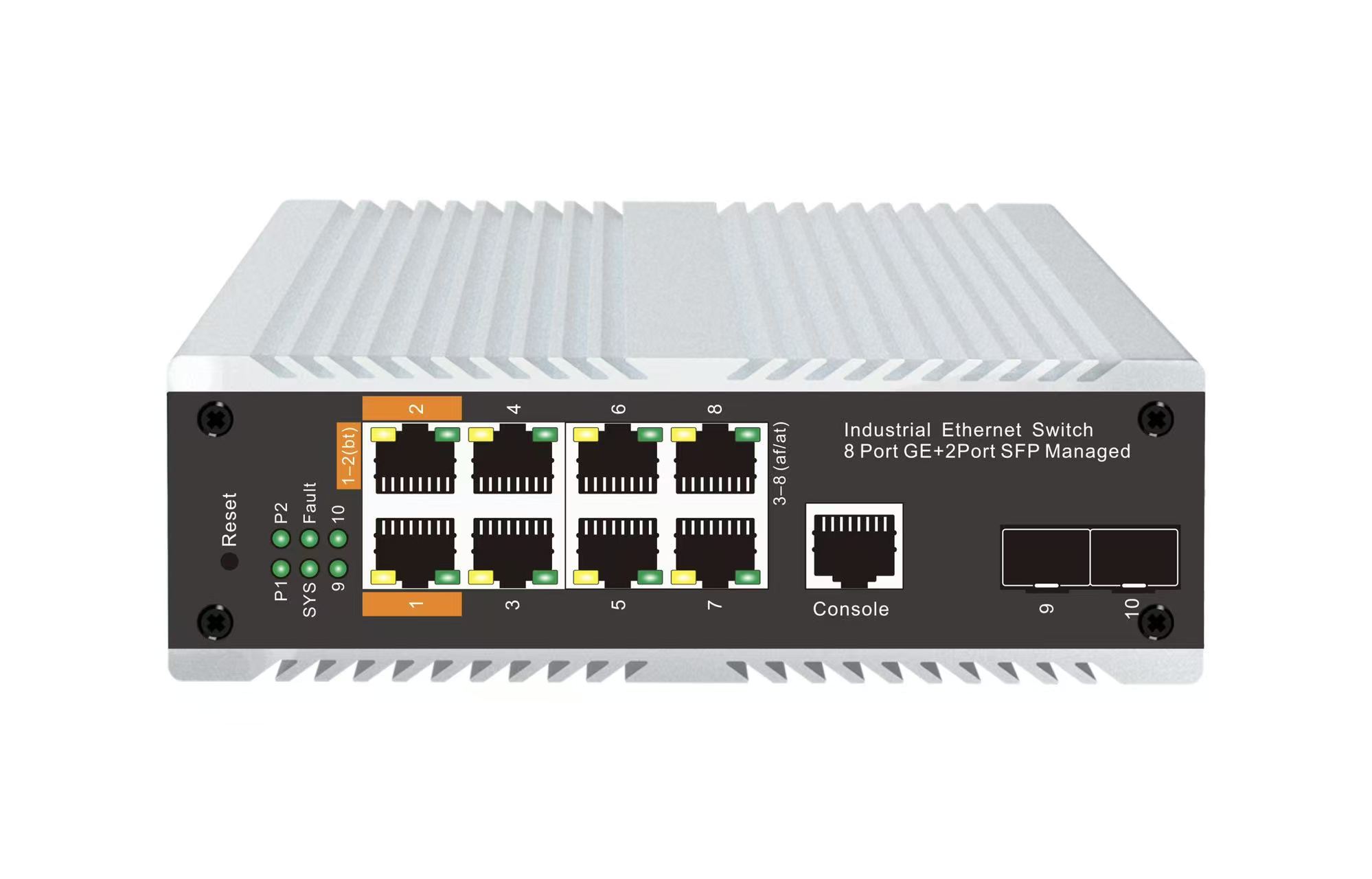
This unit features 8 Ethernet copper ports, including 2 IEEE 802.3bt PoE++ ports with up to 90 W per port. The remaining 6 ports connect to ordinary high- definition cameras, PLCs and data -acquisition terminals, enabling mixed networking for both high- power devices and conventional industrial control terminals.
Equipped with 2 Gigabit SFP uplink ports, the dual -fiber ports support long -distance fiber- based ring network cascading. It fits networking scenarios requiring interconnection of multiple switches, such as full 3C production lines, segmented lithium- battery workshops and large- scale warehouses.
It supports L2+ managed functions including VLAN, STP/RSTP/MSTP, multicast, port mirroring and QoS. Compared with basic web -only management, it delivers more comprehensive capabilities to meet fine- grained management requirements for complex network environments.
Universal Industrial -Grade Strengths of the 2 Models
•All ports auto- negotiate and identify IEEE802.3af/at/bt PoE terminals, delivering compatibility for new and legacy devices and seamless upgrade for new and retrofitted production lines
•Wide- temperature fan less thermal circuit design with aluminum alloy housing provides dust and vibration resistance. It adapts to harsh factory conditions including extreme temperature, dust and electromagnetic interference, with 6 KV surge protection.
•Full rate Gigabit forwarding ensures zero signal loss over long- distance fiber transmission, satisfying both local power supply and long- range networking requirements.
•Port rate limiting, broadcast storm suppression, multicast storm suppression and unknown unicast storm suppression are supported.
5. Conclusion
From 15W to 90W, PoE++ represents far more than merely higher power figures. It enables numerous high -power -consumption terminals to operate via a single Ethernet cable, bringing simpler, more flexible and more reliable deployment for production lines.
With the widespread adoption of AI vision, commercial availability of Wi Fi 7 and accelerated smart transformation & digital upgrading of manufacturing plants, PoE++ switches are evolving from an optional add -on into an essential component. CF FIBERLINK industrial PoE++ switches deliver dependable high- power supply solutions for your production- line upgrades.
Post time: Aug-17-2026